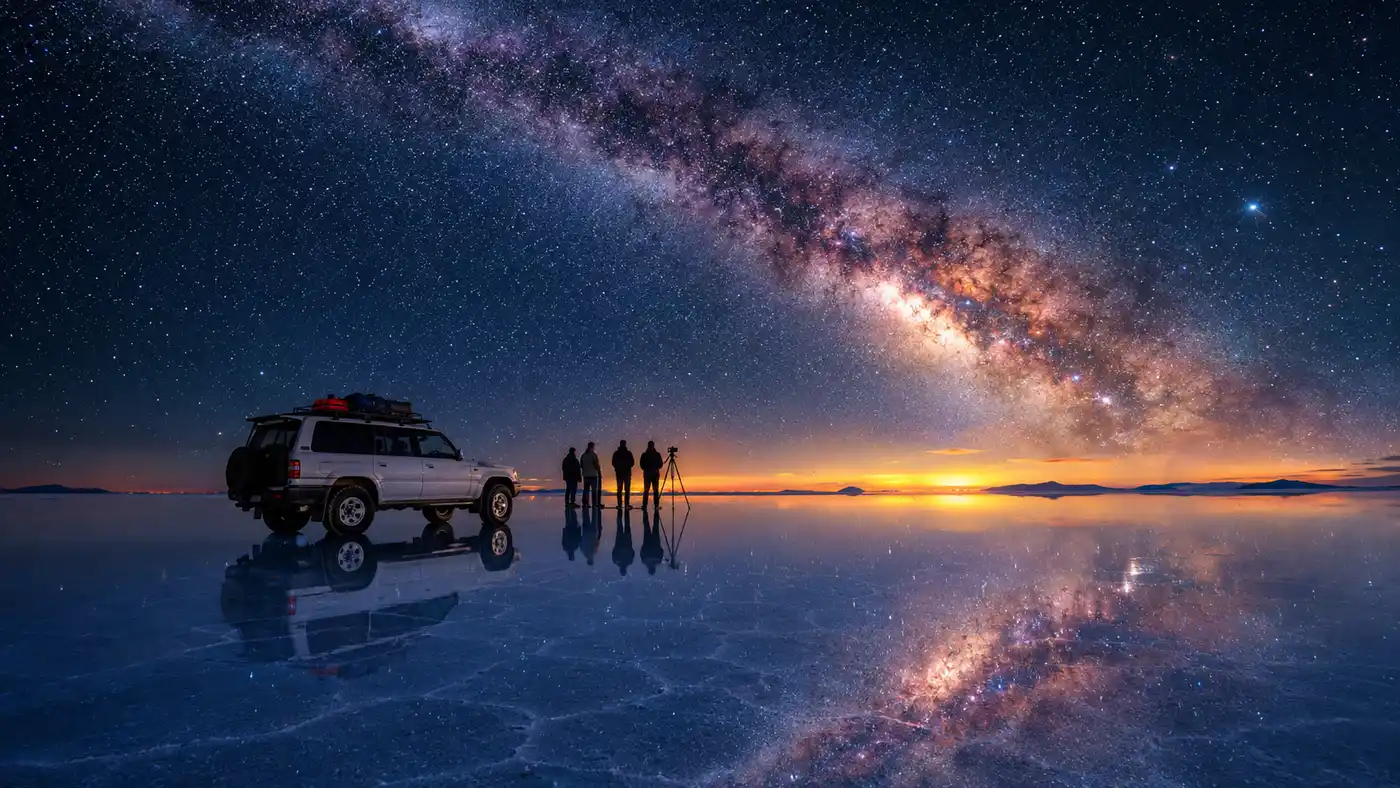
Salar de Uyuni Night and Stargazing Tours
Stepping out of an old Land Cruiser onto the world's largest salt flat at three in the morning is a shock to the system. The air at 3,656 meters is violently cold, thin, and smells faintly of sulfur and dried minerals. There is no ambient city glow to soften the darkness. When you look down on a flooded section during the wet months, the stars reflect across the surface so cleanly that you lose your balance. Booking a salar de uyuni night tour gives you access to one of the cleanest, most unpolluted night skies on the planet, but it requires enduring temperatures that will freeze water bottles solid inside your bag.
Most standard multi-day trips hurry travelers back to basic salt hostels before the sun drops behind the Tunupa volcano. They miss the main event. Salar de Uyuni night trips run on an inverted schedule, chasing the pitch darkness and the strange solitude of the Altiplano after midnight. Whether you want to witness the celestial core reflected on shallow water or stand amid dry, white geometric salt tiles under an impossibly bright Milky Way, here is what actually happens out on the flats after dark.
Book your Salar de Uyuni tour experience:
What Makes a Salar de Uyuni Night Tour Unique
The geography explains why the sky looks almost fake here. Uyuni sits on an elevated plateau in southwestern Bolivia, hundreds of kilometers from any industrial city. Uyuni town itself has streetlamps, sure, but twenty minutes out on the flats, every speck of man-made light disappears. The elevation puts you above roughly a third of the Earth's lower atmosphere. That thinner air means fewer particles between your eyeballs and the Magellanic Clouds.
Experiencing the bolivia salt flats at night changes how you perceive depth. Because the landscape is completely flat - varying by less than a meter across over 10,000 square kilometers - there are no trees, power poles, or hills to give you a sense of distance. At night, that blank flatness turns into an eerie void. Sound behaves strangely too. Voices do not bounce off anything; they just drop into the open space and die. You hear your own breath and the faint crunch of salt crystals underneath your heavy boots.
Pro tip: Schedule your trip around the new moon. Even a quarter moon will wash out the faint dust lanes of the Milky Way, turning the mirror effect into a milky gray reflection instead of a glittering starfield.
During the rainy period between January and April, thin sheets of rainwater sit atop the salt crust. On windless nights, this creates the legendary mirror. You do not just look up at the Southern Cross; you stand right in the middle of it. Looking down at your boots feels like floating in deep orbit. If you go during the dry season between May and November, you lose the mirror, but you gain crystal clear skies and the surreal texture of the dry salt crust stretching into infinity.
Tour Itineraries and Typical Night Schedules
Tour agencies based along Avenida Ferroviaria in Uyuni operate three distinct formats for anyone wanting to see the salt flats after dark. Some travelers prefer combining twilight with early darkness, while others set an alarm for 3:00 AM to combine the deepest celestial dark with dawn. A standard salar de uyuni stargazing tour generally focuses on a 4 to 5 hour window.
- Sunset and Starlight combo: Leaves town around 4:00 PM, catches the pastel twilight on the salt, stays out until roughly 9:30 PM for initial star viewing, and returns to Uyuni for a late sleep.
- Deep Night Stargazing: Departs Uyuni at 11:00 PM or midnight, drives straight to remote water patches, spends 3 hours under the darkest sky, and gets you back to your hotel before dawn.
- Starlight and Sunrise run: Departs Uyuni at 3:00 AM, catches the Milky Way at its highest clarity, and stays on the flats as the dawn turns the horizon bright neon orange.
If you ask locally for a tour salar de uyuni noche, most operators will quote you for a private vehicle or a shared group of six passengers. Private tours are infinitely better for photography because you are not competing with five other people opening car doors, turning on phone flashlights, or kicking up water ripples while your shutter is open.
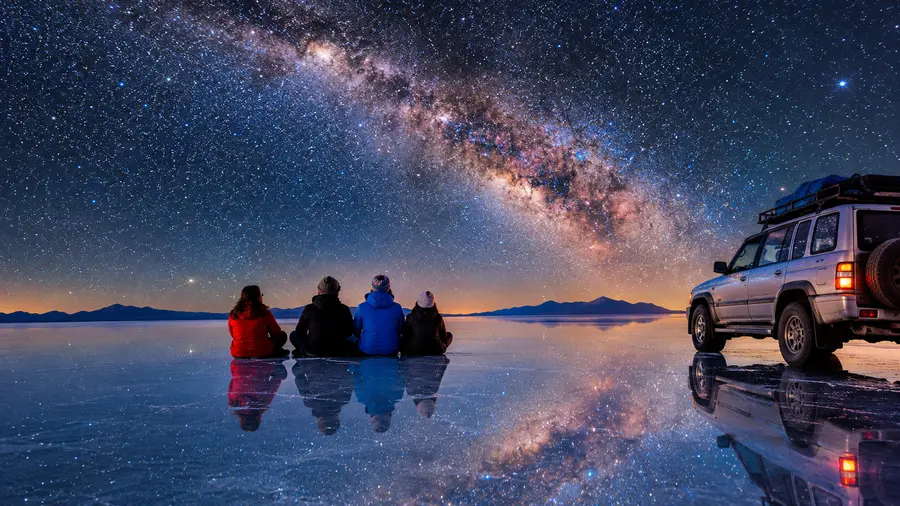
Comparing Salar de Uyuni Night Tour Options
Choosing the right tour comes down to whether you can handle waking up at odd hours or if you prefer watching the sunset first. Below is a breakdown of what typical operators in Uyuni offer for night excursions.
| Tour Type | Standard Hours | Approx. Cost (Private 4x4) | Best Suited For |
|---|---|---|---|
| Sunset + Starlight | 4:00 PM - 9:30 PM | $120 - $150 total | Casual viewers, families, warm-weather preference |
| Midnight Stargazing | 11:00 PM - 3:30 AM | $130 - $160 total | Serious astrophotographers, deepest dark skies |
| Starlight + Sunrise | 3:00 AM - 7:30 AM | $125 - $155 total | Reflective photography, sunrise lovers |
| Overnight Salt Hotel | Departs 10:00 AM (Day 1 - Day 2) | $280 - $400 total | Full daytime circuit plus walk-out night views |
Keep in mind that shared seats usually run between $25 and $40 per person if you can find an agency assembling a group for that night. Dedicated agencies like Hodaka Mountain, Oasis Bolivia, and salty-boots outfits near the train station specialize in these odd-hour runs. They know where the standing water is during the transitional months without getting their 4x4s stuck in deep mud.
Book your Salar de Uyuni tour experience:
Surviving the Freezing Conditions on the Flats
Uyuni salt flats at night are brutally cold. At this altitude, the ground sheds heat instantly the second the sun disappears. Between June and August, night temperatures regularly drop to -10°C or even -15°C. When a relentless Altiplano wind kicks up across the flats, it feels significantly worse. If your boots are wet from standing in brine water, frostbite becomes an actual risk rather than a dramatic exaggeration.
Rubber boots are usually provided by agencies for wet season tours, but cheap rubber acts like an ice box around your feet. The freezing brine water pulls body heat through the rubber within fifteen minutes. Dress in serious layers, preferably wool or down, and avoid plain cotton denim entirely.
Note: Camera batteries and mobile phones drain at quadruple their normal speed in this cold. Keep spare batteries tucked inside your inner coat pocket directly against your body heat until the second you need them.
Pack carefully before heading out. A few simple items make the difference between marveling at the sky and shivering miserably inside the Land Cruiser with the heater blasting.
- Footwear system: Two pairs of thick thermal wool socks inside oversized rubber boots, or insulated alpine boots if the flats are dry.
- Hands and head: Thin liner gloves underneath windproof mittens so you can adjust camera dials without exposing bare skin to freezing wind.
- Red headlamp: Preserves night vision for yourself and other travelers trying to navigate the darkness.
- Thermos bottle: Filled with hot coca tea or sweet coffee from town; most basic tours bring hot water, but having your own keeps you warm during long photo setups.
Timing your trip carefully will save you from frozen heartbreak. Checking our breakdown of the best time to visit Salar de Uyuni will help you align your visit with clear skies and the weather conditions you want.
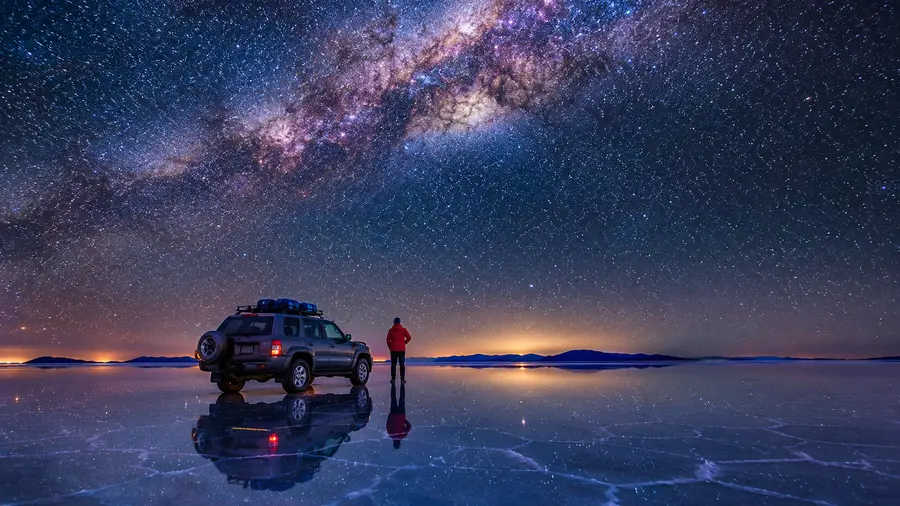
Photographing the Stars and the Mirror Effect
Taking photos during a salar de uyuni bolivia night excursion is harder than daytime perspective shots with toy dinosaurs. The dark is absolute. Your camera autofocus will hunt endlessly and fail, so switch your lens to full manual focus. Find a bright star, zoom in using your digital display, and gently rock the focus ring until the star becomes a tiny pinpoint instead of a fuzzy white disc.
A sturdy tripod is completely non-negotiable. Even a light breeze out on the flat salt will vibrate a flimsy travel tripod, blurring your long exposures. If you are standing in water, push the tripod legs firmly into the salt sediment below the slush so it does not drift mid-exposure. Be prepared to wipe down your tripod legs thoroughly with fresh water the moment you return to your hostel; dried salt brine will seize up locking joints permanently within a couple of days.
For detailed camera settings, lens recommendations, and composition tricks on the salt, read through our dedicated Salar de Uyuni photography guide. Generally, you want an exposure between 15 and 25 seconds, an aperture of f/2.8 or wider, and an ISO starting at 3200. Anything longer than 25 seconds causes the stars to trail due to the Earth's rotation.
One trick that local guides use on the tour salar de uyuni noche is light painting with cheap LED light bars. A five-second flick of soft light across the vehicle or a person standing stock-still creates an otherworldly silhouette against the Milky Way. Do not use headlamps for this - the beam is too harsh and blows out the reflection on the water.
Frequently Asked Questions about salar de uyuni night tour
Is it possible to see the night sky on a standard 3-day tour?
Usually no. Standard budget 3-day tours sleep in villages or salt hotels off the flats, often arriving late and locking the gates at night for safety and heat retention. If you want guaranteed stargazing on the salt itself, you must book an express night tour directly out of Uyuni town or pay for a custom private itinerary.
Can I do a stargazing tour during the dry season?
Yes, and many travelers prefer it. You will not get the water reflection, but the dry season (May to October) brings the clearest skies of the year with virtually zero cloud cover. The white salt crust looks like snow under the stars.
How far out do the 4x4s drive for stargazing?
Most drivers take you between 20 and 45 minutes onto the salt flats, heading past the Colchani access point. They drive far enough that light from Uyuni town and passing highway trucks drops completely beneath the flat horizon.
Are night tours safe given the lack of roads?
They are safe when using experienced local drivers who know the flats intimately. The salt flats have no signposts, marked lanes, or cell service. Drivers navigate at night using mountain silhouettes, GPS points, and surface tracks. Never attempt to drive a rental vehicle out onto the flats at night alone.
Quick Reference
- Departs Uyuni town between 11 PM and 3 AM
- Night temperatures regularly dip below -10°C
- Mirror reflections require wet season (Jan to April)
- Sturdy tripod and manual focus essential
Book your Salar de Uyuni tour experience:
The Reality of Freezing for Stars
It is easy to look at glossy photos online and forget that standing on the salt flats at 4:00 AM is physically exhausting. Your fingers will ache from the cold, your nose will run, and the thin air makes every short jog to position a camera leave you breathless. Yet the moment the driver kills the headlights, the sheer scale of the cosmos above the salt leaves everyone in the vehicle completely quiet. If you have an extra night to spare in Uyuni before or after your main circuit, bundle up, buy some hand warmers, and head out into the dark.
Read more about Salar de Uyuni tour.